



| Wolvert Acker
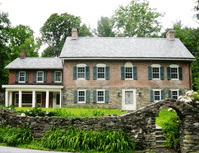
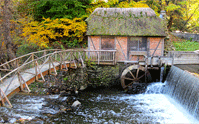
Wolvert Ecker descended from a prominent Dutch family that arrived in New Netherlands in 1655. Wolvert was the namesake grandson of the Wolfert Ecker immortalized in Washington Irving's short story "Wolfert’s Roost" which was printed well after the grandson had passed. On January 13, 1772,purchased the Mill House in a sheriff's foreclosure on Jacobus Van Blarckem. Ecker was the high bidder for the property, agreeing to pay 835 pounds, 19 shillings to include the quit rents, judgments and mortgages to His Majesty. At that time the town of Newburgh (and the House) was in the Ulster County. When Gomez built the original one story house, he dug deep into a hill on the north side for his rear wall. We know that Wolfert Ackert began improvements and additions to the Mill House, now the Gomez Mill House, about 1772 Ackert added the second floor and had an entrance to the house second story from on top of the hill. However, the hillside was removed in two excavations, one ca. 1882 and the other in 1932, thereby eliminating this second floor entrance. Ackert’s slaves used homemade moulds and fetched the clay from the banks of the Hudson to make the bricks in the meadow across Mill House Road to add the second story. Acker’s brick alterations to Gomez’s one story stone building completely changed the appearance of the building. Acker developed the house in a vernacular five bay version of the popular Georgian style employing local building traditions. The upper story centerpiece for the symmetrical house was a Palladian window. The second story brickwork, laid in Fleming and in some places, Liverpool bond, is particularly distinctive. On the east side, in bricks glazed black by the hot fires in the kiln, is a design of a diamond surrounding a heart reflecting Dutch construction influence in the valley. Families following Ackert’s residency continued using this theme and Dard Hunter in 1883 added a wrought iron heart to the front door and also made handmade paper using a heart watermark. (In welcoming today’s many visitors, the docents point out Ackert’s design and say, If you have a warm heart, you too are welcome here at Mill House.) Wolfert Ackert was a regionally prominent Revolutionary patriot and the Mill House at Ackert’s farm was a local center for Whig activity during that time. Ackert was an important figure in the Committee of Safety in Newburgh, one of the early Town Supervisors and was known as a “zealous Whig” and a first-rate Tory hunter. He was commissioned a first Lieutenant on December 1, 1775 in the New Marlborough Company, Southern Regiment of Minute Men. On the Sabbath, area farmers and residents would gather at this house and Wolfert would open the meetings with a reading from his old Dutch family Bible, after which they discussed War news and planned anti-Tory activities. Today, in a prominent position in the dinning room, is Wolfert’s wooden Bible box, a gift from his descendants. It must suffice here to say that after the war, Wolfert Ackert prospered, with several grist mills on the former Jews Creek, now called Acker’s Creek, a ferry on the Hudson, a packet line to New York, and extensive commercial activities in the mid-Hudson region. Wolfert’s son, Colonel William Acker, went in for sports, good living, and politics. The order of preference is suggested by the fact that although he did spend some time in the legislature at Albany – where he died on the Assembly Room’s floor - his sportsman and gambling habits apparently got the better of him, for the Mill House and property was sold as it was acquired, at a foreclosure sale to the next family, the Armstrong’s of Danskammer. |


Home | About Us | Gallery G | Events | Donations | Membership | Visitors | Volunteers | Press | Contact Us | Directions | Privacy